
Disclaimer: MRO is committed to providing non-binding guidance to industry stakeholders on important industry topics. Subject matter experts from MRO’s organizational groups have authored some of the articles in this publication, and the opinion and views expressed in these articles are those of the author(s) and do not necessarily represent the opinions and views of MRO. The following article was authored by Nandaka Jayasekara, Senior NERC Reliability and System Studies Engineer, Manitoba Hydro, and Lynn Schroeder, Senior Manager of Engineering Planning, Design, and Protection, Sunflower Electric Power Corporation.
The ERO Enterprise endorsed Implementation Guidance for TPL-001-5.1 Trip Circuit Monitoring in November 2025. The guidance document was prepared by the NERC System Protection and Control Working Group (SPCWG) to serve as a reference for applicable functional entities (Planning Coordinators and Transmission Planners) when evaluating and defining the scope of work required to meet compliance with NERC standard TPL-001-5.1 (Transmission System Planning Performance Requirements), Table 1, Footnote 13.d, which reads: “A single control circuitry (including auxiliary relays and lockout relays) associated with protective functions, from the dc supply through and including the trip coil(s) of the circuit breakers or other interrupting devices, required for Normal Clearing (the trip coil may be excluded if it is both monitored and reported at a Control Center).”
The NERC Reliability Standard TPL-001-4 was revised under Project 2015-10: Single Points of Failure, to form the currently applicable version TPL-001-5.1, which became effective in July 2023. Table 1, Category P5 and Footnote 13 were updated from specific relay functions to include non-redundant components of a Protection System, such as a single communication system, a single station DC supply, single control circuitry (including auxiliary relays and lockout relays), including the trip coil(s) of the circuit breakers or other interrupting devices. Footnote 13 provides an exclusion for a single trip coil if it is monitored and reported at the Control Center. The implementation guidance helps registered entities evaluate and determine if monitoring systems are applicable to footnote 13d.
Implementation guidance is developed by industry experts and reviewed by pre-qualified organizations before undergoing a review and approval process by the ERO Enterprise. The NERC SPCWG saw a need for clarification of the Trip Circuit Monitoring (TCM) acronym to aid enforcement of TPL-001-5.1. The implementation guidance provides a specific example and visual of a Trip Circuit Monitor that includes a trip circuit coil. The SPCWG worked closely with NERC’s Reliability and Security Technical Committee (RSTC) and ERO Enterprise staff to ensure the document was approved and available to entities.
About Trip Circuit Monitors
Substation DC control circuit design typically incorporates a TCM within the control room to monitor the combined configuration of the trip circuit and the interrupter “trip coil.” The TCM functions by detecting a loss of voltage or a loss of circuit continuity between the positive source terminal and the negative source terminal of the circuit. The implementation guide clarifies that the exception referenced in footnote 13d includes not only the trip coil, but also the circuitry monitored by the TCM.
The following example from the guidance document shows a DC control circuit with trip circuit monitoring that meets the exclusion condition of footnote 13d in terms of monitoring and reporting to a control center. It is assumed that the Protection System has redundant protective relays with a TCM that monitors all the single trip circuit components, including the single trip coil. The TCM sends alarm signals to the Control Center when it detects any discontinuity in the trip circuit, including the trip coil.
Such a configuration would qualify for the footnote 13d exclusion. However, a trip circuit containing non-redundant lockout and/or auxiliary relays would not qualify for exclusion and would have to be assessed according to TPL-001-5.1, Table 1, Category P5.
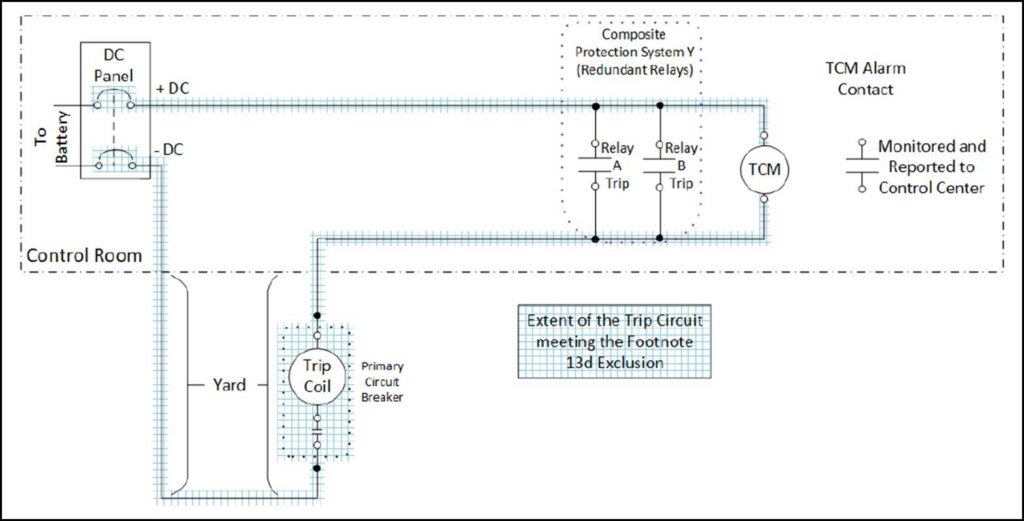
Figure 1: Redundant protective relays with a trip circuit monitor (TCM) that monitors all of the single trip circuit components, including a single trip coil (source: Implementation Guidance TPL-001-5.1 Trip Circuit Monitoring).
The implementation guidance for TCM is an excellent resource for applicable entities as they evaluate and identify TPL-001-5.1, Table 1, Footnote 13.d applicability.
About the Authors

Nandaka Jayasekara is a Senior NERC Reliability and System Studies Engineer in the Grid Infrastructure Planning Department at Manitoba Hydro with over 17 years of experience in transmission system planning and NERC regulatory compliance. He holds a B.Sc. in Electrical Engineering (First Class Honors) from the University of Moratuwa, Sri Lanka, and M.Sc. and Ph.D. degrees in Electrical Engineering from the University of Manitoba, Canada. Nandaka specializes in power system studies, including electromagnetic transient (EMT) analysis and real-time digital simulation to support major capital projects and to integrate emerging technologies. Since 2012, he has led the NERC compliance activities in the Grid Infrastructure Planning Department at Manitoba Hydro. He has been a member of the Midwest Reliability Organization’s Reliability Advisory Council (MRO-RAC) since 2019, where he represents Manitoba Hydro as a Planning Coordinator. He also serves the Standard Drafting Team established for NERC Project 2022-04 EMT Modelling, which aims to revise FAC-002, MOD-032, and TPL-001 standards to incorporate EMT modelling and study requirements.
Nandaka is a registered Professional Engineer in the province of Manitoba and a member of the Institute of Electrical and Electronics Engineers (IEEE).

Lynn Schroeder is the Senior Manager of Engineering Planning, Design, and Protection at Sunflower Electric Power Corporation. She serves as the MRO representative and chair of the NERC System Protection and Control Working Group (SPCWG). She also serves as a member of the North American Transmission Forum (NATF) System Protection Practice Group CORE team. She has over 30 years of utility experience including event analysis, schematic design, calculation of protective relaying setpoints, and protective relay configuration for transmission, substation, and generation protection systems. She has served as an adjunct professor teaching AC Circuits, Power System Analysis and Design and is a member of the Wichita State University EECE Advisory Board. She has been part of several industry teams drafting and presenting protection related material including the NERC SPCWG, SPP System Protection and Control Advisory Group, IEEE Power System Relaying and Control Committee, NATF, and industry Protective Relaying Conferences.