
Disclaimer: MRO is committed to providing non-binding guidance to industry stakeholders on important industry topics. Subject matter experts from MRO’s organizational groups author some of the articles published by MRO, and the opinion and views expressed in these articles are those of the author(s) and do not necessarily represent the opinions and views of MRO. The following article was coordinated through MRO’s CMEP Advisory Council and written by James Rowan, Critical Infrastructure Security SME, Force 5, Inc..

Introduction – Why the Status Quo Won’t Cut It
In modern industrial operations, safety, security, and compliance are frequently treated as after‑thoughts—isolated line‑items managed by separate business units. The result is a patchwork of reactive solutions that leave critical gaps at the very places where people and assets intersect: doors, gates, and checkpoints that define every facility.
Because environments differ—lobbies, outdoor yards, harsh industrial zones—and because the people who occupy them vary in role, trust level, and clearance, a one‑size‑fits‑none approach inevitably creates “entry‑point risk.” The following article examines real‑world failures that expose these gaps and outlines a cohesive, gate‑centric framework for eliminating vulnerability across the entire enterprise.
The Common Pitfalls That Keep Risk Alive
| Problem | How It Manifests |
| Fragmentation | Silos produce inconsistent tools, policies, and enforcement standards. |
| Reactivity | Solutions are deployed after an incident, not before it occurs. |
| Resource Constraints | Small teams juggle multiple roles, especially at remote or unmanned sites. |
| Inadequate Technology | Paper based or non-industry specific systems can’t adapt to diverse settings and requirements, leaving seams in coverage. |
| Geographic Distance | Limited oversight at field locations allows risks to fester unchecked. |
| Weak Internal Controls | Shared credentials, expired permissions, and weak controls are easy to bypass. |
These factors reinforce a culture of “acceptable high risk,” exposing organizations to preventable threats that could jeopardize personnel, assets, and reputation.
Real‑World Use Cases – Lessons From The Field
1. Whose Car Is This?
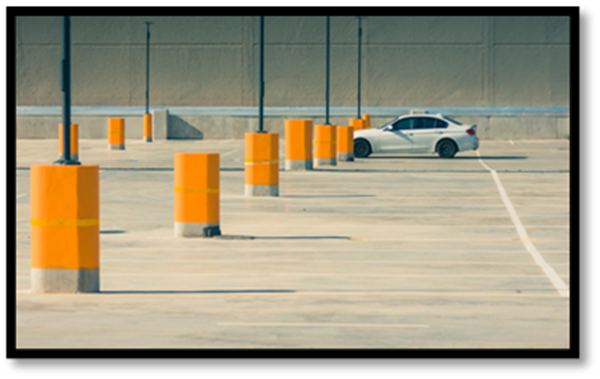
During a planned outage, a contingent worker slipped off a dock into icy water and remained undiscovered for hours. A colleague eventually noticed an abandoned car in the lot, prompting a frantic rescue.
Root cause: No automated check‑in for contingent staff.
Prevention: Real‑time situational awareness of every individual on site.
2. Catch Me If You Can!
A terminated contractor resurfaced at a neighboring plant a week later, undetected for seven days. Two weeks after that, he accessed a nuclear facility across state lines before being identified.


Root cause: Absence of enterprise‑wide watchlist integration for contingent check‑ins.
Prevention: Centralized watchlists with instant validation at every entry point.
3. Flash Mob
On the first day of an outage, a lone guard relied on a handwritten sign‑in sheet. An influx of workers arrived simultaneously, overwhelming the process and compromising security.

Root cause: No pre‑validation of workforce needs or identities.
Prevention: Automated credential issuance and business‑justification checks before entry.
These incidents illustrate a single truth: Without unified validation at every gate, risk compounds exponentially.
Entry‑Point Risk – The Universal Challenge
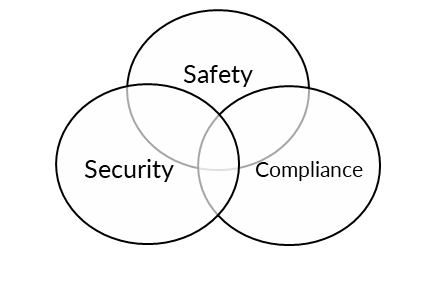
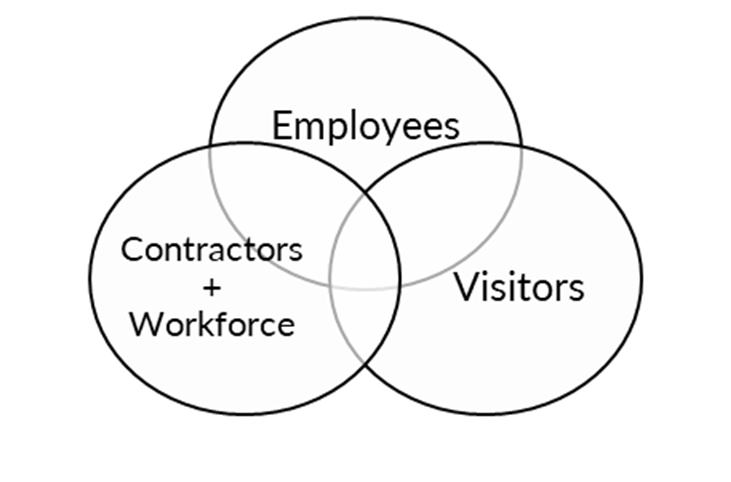
Every door, gate, and checkpoint must enforce a unique blend of safety, security, and compliance requirements—for employees, contractors, and visitors alike. Yet most organizations fail to apply these controls consistently, resulting in wildly inconsistent processes and enforcement.
Typical Gaps
Security: Unvetted visitors, missing identity verification, absent credential issuance, no real‑time situational awareness.
Safety: No health screenings, lacking dashboards or alerts, undefined muster points, static safety plans that don’t adapt on the fly.
Compliance: Incomplete or illegible visitor data, insecure data collection, insufficient audit‑report generation, misalignment with regulations such as CIP and OSHA.
Why Organizations Accept High Risk
- Resource Constraints – Front‑line staff wear many hats, diluting enforcement. Guard ratios drop during high‑demand events (e.g., outages).
- Tech Fragmentation – Departments select siloed solutions that don’t interoperate, creating patchwork deployments and administrative overhead.
- Geographic Distance – Remote sites lack automated controls; enforcement falls to frontline or contract workers.
- Weak Internal Controls – Simple QR code sharing, expired escort permissions, and casual gate approvals become easy workarounds.
A Unified Framework – Logging, Validating, Discovering, Enforcing
1. Choose Technology Together: Involve safety, security, and compliance stakeholders from the outset. Select a platform that can satisfy every entry requirement, regardless of environment.
2. LOG – Capture Everyone, Everywhere: At each entry point, record three core factors:
- Something you have (badge, token, QR code)
- Something you know (PIN, password)
- Something you are (biometric)
This “three‑factor” capture creates an immutable audit trail for every individual, every location.
3. VALIDATE – Real‑Time Policy Enforcement: Beyond identity, the system must verify:
- Watchlist status – Flag individuals denied elsewhere.
- Certifications & Training – Confirm required safety orientations and competency records.
- Location‑Specific Controls – Enforce escorts, health screenings, and contractual agreements per site.
All checks happen instantly, preventing entry before a violation occurs.
4. ENFORCE – Automate, Don’t Manual‑Check: Human error is inevitable; automation isn’t. Deploy rules that automatically deny, quarantine, or flag non‑compliant attempts. Integrate with existing guard workflows so that alerts surface in real time, not after the fact.
5. DISCOVER – Visibility & Reporting: Provide centralized dashboards that slice data by facility, gate, or risk category. Enable one‑click generation of audit reports aligned with CIP, OSHA, and other regulatory frameworks. Instant visibility empowers rapid response and continuous improvement.
6. BONUS – Adapt to Any Environment
- All Climates & Locations – Rugged hardware and offline‑first software keep validation functional in lobbies, generation plants, outdoor yards, and extreme weather.
- Low‑Connectivity Sites – Edge processing and local caching allow seamless operation where cellular or broadband is scarce, syncing data back to headquarters when connectivity returns.
Conclusion – Secure Every Gate, Protect Everything Else
Fragmented, reactive approaches invite disaster. By logging, validating, discovering, and enforcing at every entry point—using technology chosen collaboratively and built to survive any environment—organizations transform compliance from a cost center into a proactive shield.
Start today: conduct a gate‑by‑gate assessment, consolidate your tech stack, and embed unified policies across safety, security, and compliance. Your people, assets, and reputation depend on it.
About the Author

Jim Rowan is the Critical Infrastructure Security and Compliance SME at Force 5 which specializes in Visitor Management solutions for Power Utilities including CIP-006 R2 regulatory compliance and mitigation. Jim is a retired U.S. Marine Corps officer where he worked in Special Operations and was a carrier-based jet aviator. He was the Security Program Manager at the North American Transmission Forum (NATF) and the Security and CIPC Manager at SERC. He’s been the Critical Infrastructure Security Principal at Alitek Security based out of Houston, Texas where he worked with numerous companies in the electric utilities and the global petro chemical industry. Jim was a certified Security Auditor at Shell Oil.
Jim holds a BS from the US Naval Academy, an MBA and MIS from the University of Maryland, and a ABD PhD from Lasalle University. He is a published author to the security industry and passionate about security and the holistic approach that is needed in today’s world. He lives in Houston, Texas with his wife of 43 years, Marian.
[email protected], https://www.linkedin.com/in/james-rowan-6a23b31/